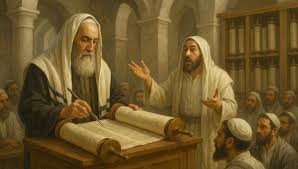
The Authorship of the Pentateuch:
Source-Critical, Linguistic, and Textual Evidence
Introduction
The authorship of the Books of Moses—Genesis, Exodus, Leviticus, Numbers, and Deuteronomy—has been a subject of extensive scholarly debate for well over two centuries. Traditionally, religious communities attributed these texts to Moses himself. However, modern biblical scholarship, drawing upon literary analysis, linguistics, comparative ancient Near Eastern literature, and manuscript evidence, has arrived at a broad consensus that the Torah is a composite work assembled from multiple sources composed by different authors across several centuries. The following discussion examines the principal evidence in support of this conclusion.
Part I: The Documentary Hypothesis
The most influential framework for understanding the composition of the Pentateuch is the Documentary Hypothesis, which posits that the Torah was compiled from at least four major source traditions: the Yahwist (J), the Elohist (E), the Deuteronomist (D), and the Priestly source (P). While the precise boundaries of these sources remain a matter of ongoing scholarly discussion—and while some scholars prefer supplementary or fragmentary models—the core observation that the text exhibits duplicate narratives, contradictions, and distinct linguistic and theological registers is broadly accepted across these competing models. As Joel S. Baden argues in The Composition of the Pentateuch, the sources are sufficiently coherent to be identified as continuous documents even where their exact limits remain debated.[1] Disagreement over the boundaries of sources does not negate the underlying evidence for composite authorship.
The Yahwist Source (J)
The Yahwist tradition is generally regarded as one of the oldest strands within the Documentary Hypothesis, tentatively dated to the tenth or ninth century BCE and likely associated with the early Israelite monarchy in Judah. Several features distinguish it from the other sources.
Most notably, the Yahwist employs the divine name Yahweh (YHWH) from the outset of the narrative, including in primeval history, in contrast to the Elohist and Priestly sources, which reserve this name for its revelation to Moses.[2] This consistent usage reflects a particular theological stance: that Israel’s God had always been known by this name, a claim that stands in deliberate tension with the Priestly account in Exodus 6:2–3, where Yahweh declares that the patriarchs knew the deity only as El Shaddai.[3]
The Yahwist also presents a markedly anthropomorphic portrayal of the divine. Yahweh walks in the Garden of Eden (Genesis 3:8), personally forms Adam from the dust (Genesis 2:7), and engages in direct dialogue with human figures. This intimate theological vision differs substantially from the more transcendent and mediated presentations found in later sources. Narratively, the Yahwist is rich and character-driven, featuring psychologically developed figures and morally complex encounters. Its geographical and political orientation appears to favor southern, Judahite concerns, centering on figures such as Abraham and locations associated with the southern kingdom.
The Elohist Source (E)
The Elohist tradition is generally associated with the northern kingdom of Israel following the division of the monarchy around 930 BCE. It is distinguished by its consistent use of the divine title Elohim prior to the revelation of the divine name at the burning bush (Exodus 3:14–15), implying a theological position that the personal name Yahweh was not known to the patriarchs—a claim that directly contradicts the Yahwist’s assumptions.[4]
The Elohist presents a more transcendent deity who communicates through dreams, visions, and angelic intermediaries rather than through direct physical encounters. The binding of Isaac (Genesis 22) is a paradigmatic example: an angel intervenes to halt the sacrifice rather than God appearing in person. This mediating structure reflects a theological sensibility that maintains a greater distance between the divine and the human.[5]
The Elohist tradition also places considerable emphasis on prophetic figures and moral themes consistent with the religious concerns of the northern kingdom.[6] Abraham is explicitly designated a prophet (Genesis 20:7), and dream interpretation features prominently in the Joseph narratives. Geographically, the Elohist elevates northern sites such as Shechem and Bethel and traditions connected to northern tribes, suggesting its origin in a distinct regional milieu. The Elohist source survives in fragmentary form and is generally thought to have been combined with the Yahwist material by later editors, producing a composite JE strand.[7]
The Deuteronomist (D)
The Deuteronomist source is closely associated with the religious reforms of King Josiah of Judah, typically dated to around 622 BCE, and with the broader process of centralization and legal codification described in 2 Kings 22–23.[8] The “discovery” of a book of the law during Josiah’s reign—widely identified by scholars with an early form of Deuteronomy—served as the programmatic basis for a sweeping reform that abolished local shrines, outlawed worship outside Jerusalem, and purged what the reformers regarded as syncretic practices.[9] The literary and theological character of this source reflects these concerns directly.
Theologically, the Deuteronomist is defined by a strict monolatrous or monotheistic insistence on the exclusive worship of Yahweh at the single chosen sanctuary in Jerusalem (Deuteronomy 12:5–14), and by a covenantal framework that ties national prosperity to obedience and national catastrophe to apostasy.[10] This retributive schema operates as the organizing principle of the Deuteronomistic History—the books of Joshua, Judges, Samuel, and Kings—which interprets the fall of the northern kingdom in 722 BCE and the later Babylonian exile as consequences of covenant infidelity.[11]
Unlike the more unconditional promise to Abraham found in the Yahwist tradition, the Deuteronomistic covenant is explicitly conditional: obedience results in blessing, while disobedience brings curse, defeat, and exile. The legal material in Deuteronomy revisits and in some cases revises earlier legislation found in Exodus, a feature that points to the Deuteronomist as a distinct editorial layer rather than a unified composition with those texts.
The Priestly Source (P)
The Priestly source is generally dated to the sixth or fifth century BCE, with many scholars associating its composition or final redaction with the period of the Babylonian Exile or the early post-exilic community. It is distinguished by its systematic, formal style and its preoccupation with genealogies, ritual regulations, sacrificial law, and the organization of the priesthood.[12]
The Priestly account of creation in Genesis 1 is representative of its literary character: God creates through sovereign speech, in an ordered sequence culminating in the sanctification of the Sabbath, with no anthropomorphic features whatsoever. This stands in marked contrast to the Yahwist’s creation account in Genesis 2, where Yahweh physically molds humanity from earth and engages in direct interaction. The two accounts cannot be harmonized without difficulty, and their coexistence in the text is itself evidence of editorial combination rather than unified authorship.
The Priestly source traces the lineage of the priestly families, particularly the descendants of Aaron, and provides the legal and ceremonial infrastructure for Israelite religion. Its concerns reflect a community engaged in defining and defending its religious identity, likely in the context of exile or restoration. The name Yahweh is, in the Priestly account, explicitly withheld until the revelation at Exodus 6, reinforcing the theological distinction from the Yahwist tradition.
Part II: Linguistic Evidence
Linguistic analysis provides independent support for the composite nature of the Torah. The Hebrew preserved across the Pentateuch represents several distinct linguistic registers that correspond to different historical periods.[13]
Archaic forms consistent with early pre-monarchic Hebrew are found in certain poetic passages, such as the Song of Deborah (Judges 5), which provides a comparative benchmark for the earliest stratum of the language.[14] Classical Hebrew, characteristic of the monarchic period roughly between 1000 and 586 BCE, predominates in the narrative sections of the Pentateuch. A later register, sometimes described as transitional or post-classical Hebrew, appears in material associated with the Priestly source and shows affinities with texts produced during or after the Babylonian Exile.[15]
Vocabulary variation reinforces these temporal distinctions. Certain technical terms for ritual practices appear to reflect the specialized concerns of priestly circles in the exilic period, while legal terminology in the Deuteronomistic material overlaps with the language of royal administration in the late monarchy.[16] The presence of Aramaic loanwords in portions of the text similarly reflects exposure to Aramaic as a lingua franca of the ancient Near East, a phenomenon most consistent with the late monarchic or exilic periods.[17]
Theological vocabulary also shifts across the sources. The movement from the personal, emotionally responsive deity of the Yahwist to the transcendent, ritually oriented God of the Priestly source is not simply a literary variation; it corresponds to a discernible development in Israelite religious thought across several centuries.[18] No single author writing at a single point in time would be expected to produce such a range of linguistic and theological registers.
Part III: Mesopotamian and Canaanite Literary Parallels
The relationship between the Pentateuch and earlier ancient Near Eastern literature has been a major area of scholarly investigation since the discovery of cuneiform texts in the nineteenth century.[19] The parallels identified between biblical and Mesopotamian texts do not imply simple borrowing, but they do indicate that the biblical authors were operating within a shared literary and cultural environment and were engaging with, adapting, and reinterpreting existing traditions.[20]
The flood narrative in Genesis 6–9 presents well-documented parallels with the flood account in the Epic of Gilgamesh, particularly the Utnapishtim episode, and with the earlier Atrahasis Epic.[21] Both biblical and Mesopotamian traditions feature a divinely chosen figure who survives a catastrophic inundation by constructing a vessel, preserving both human life and animal life, and receiving a divine covenant or blessing following the flood’s recession. The Hebrew narrative itself contains internal tensions—variations in the duration of the flood, the number of animals taken aboard, and the identity of the bird released—that are consistent with the combination of two source traditions (J and P) rather than a single unified account.[22]
The creation account in Genesis also invites comparison with the Babylonian Enuma Elish, which depicts cosmic order emerging from primordial chaos through divine conflict.[23] Genesis 1 and Genesis 2 present two distinct and not easily harmonized accounts of creation: the first, associated with the Priestly source, describes a structured, six-day creation through divine speech; the second, associated with the Yahwist, presents an intimate account of the formation of humanity from earth and of woman from the man’s rib. While the theological framework of the biblical accounts differs substantially from the polytheistic assumptions of the Enuma Elish, the structural and thematic resonances suggest that the biblical authors were consciously working within and against existing cosmological traditions.
Comparable observations apply to the legal material of the Pentateuch. The laws in Exodus and Deuteronomy share structural and thematic features with the Code of Hammurabi and other ancient Near Eastern legal corpora, including the use of casuistic formulations and the regulation of similar social situations.[24] These parallels indicate that Israelite legal traditions developed within a broader ancient Near Eastern context rather than in isolation, further complicating the claim of a single divinely dictated authorship.
Part IV: Internal Evidence Against Mosaic Authorship
The text of the Pentateuch itself contains several features that are difficult to reconcile with Mosaic authorship. The most direct of these is the account of Moses’ death and burial in Deuteronomy 34, which is written in the third person and includes details that Moses could not plausibly have recorded. More broadly, Moses is referred to throughout the narrative in the third person—”the Lord spoke to Moses,” “Moses said to the people”—a narrative stance unusual for a first-person author and more consistent with later biographical composition.
The text also contains anachronisms that point to authorship after the period traditionally associated with Moses. Genesis 36:31 refers to “the kings who reigned in the land of Edom, before any king reigned over the Israelites,” a formulation that presupposes knowledge of the Israelite monarchy, which is generally dated to the early first millennium BCE, several centuries after the putative Mosaic period. Similarly, the place name Dan in Genesis 14:14 reflects a designation not attested until the period of the Judges (see Judges 18:29), when the tribe of Dan renamed the site.
Legal contradictions and duplications within the Pentateuch further complicate the notion of unified authorship. The Ten Commandments in Exodus 20 are followed in Exodus 21–23 by a body of case law that in some respects stands in tension with those principles. Leviticus introduces an extensive and distinct system of ritual purity regulations. Deuteronomy revisits and revises much of the earlier legislation, in some cases altering penalties and conditions in ways that suggest a distinct editorial hand rather than a consistent authorial voice. These patterns of repetition, contradiction, and revision are most naturally explained as the product of editorial combination over time rather than unified original composition.[25]
Part V: Manuscript Evidence and Textual Plurality
The manuscript evidence from the Dead Sea Scrolls has significantly deepened scholarly understanding of the Pentateuch’s textual history, and in important respects reinforces rather than undermines the case for compositional complexity.[26] The Scrolls, discovered from 1947 onward at Qumran and other sites near the Dead Sea, preserve pentateuchal manuscripts representing multiple distinct textual traditions that were apparently in circulation simultaneously during the Second Temple period.[27]
Among the manuscripts identified are examples aligned with the proto-Masoretic text (the ancestor of the traditional Hebrew Bible), pre-Samaritan texts (aligned with the Samaritan Pentateuch), and texts reflecting the Hebrew Vorlage of the Septuagint—the ancient Greek translation—which diverges from the Masoretic Text in numerous places.[28] The coexistence of these traditions at a single site and within a relatively narrow time frame strongly suggests that the Pentateuch had not been definitively standardized as a single fixed text by the late Second Temple period. This is a picture of a fluid and pluriform textual history, not one of early stabilization.[29] The implications of this manuscript evidence have been extensively analyzed by Emanuel Tov in Textual Criticism of the Hebrew Bible, which remains the standard scholarly treatment of the subject.[30]
The Samaritan Pentateuch provides a related line of evidence. This tradition differs from the Masoretic Text in thousands of places, ranging from orthographic variations to significant theological variants, the most notable of which involves the addition of a commandment to build an altar on Mount Gerizim—a distinctively Samaritan theological interest.[31] As Magnar Kartveit demonstrates in The Origin of the Samaritans, such distinctively Samaritan features are most plausibly understood as later editorial additions rather than original elements of the text, pointing to ongoing textual development and adaptation well into the post-exilic period.[32] James D. Purvis, in The Samaritan Pentateuch and the Origin of the Samaritan Sect, similarly argues on the basis of linguistic and orthographic evidence that the Samaritan textual tradition reflects developments as late as the Hasmonean period.[33]
Taken together, the Dead Sea Scrolls manuscripts and the Samaritan Pentateuch indicate that the Pentateuch remained a living and developing body of text for an extended period. Rather than pointing to a single original composition preserved intact, the manuscript record testifies to a text that was shaped by successive editorial processes—a conclusion consistent with the source-critical analysis discussed above. Israel Finkelstein and Neil Asher Silberman, in The Bible Unearthed, situate these textual processes within the broader archaeological and historical context of ancient Israel, reinforcing the view that the formation of the Pentateuch was deeply embedded in the political and religious history of its time.
Conclusion
The convergence of evidence from source criticism, linguistic analysis, comparative ancient Near Eastern literature, internal textual examination, and manuscript tradition supports the conclusion that the Pentateuch is a composite work produced by multiple authors and editors across several centuries, rather than a unified composition attributable to Moses. The Documentary Hypothesis, while subject to ongoing refinement and debate, identifies real features of the text—duplicate narratives, theological inconsistencies, distinct linguistic registers, and divergent legal traditions—that are most coherently explained by a model of multiple sources and editorial combination. The manuscript evidence from the Dead Sea Scrolls and the Samaritan Pentateuch further demonstrates that the text continued to develop and circulate in pluriform versions well into the Second Temple period. These findings do not necessarily bear on the theological significance of the Torah for religious communities, but they are the settled conclusions of the critical-historical study of the Hebrew Bible.
[1] Joel S. Baden, The Composition of the Pentateuch: Renewing the Documentary Hypothesis (New Haven, CT: Yale University Press, 2012).
[2] Joel S. Baden, The Composition of the Pentateuch: Renewing the Documentary Hypothesis (New Haven, CT: Yale University Press, 2012), 25–40.
[3] Dawn Wilson, “What Is the Meaning of the Name El Shaddai?,” Bible Study Tools, October 14, 2022, https://www.biblestudytools.com. “El Shaddai” in Hebrew means “God Almighty.”
[4] Joel S. Baden, The Composition of the Pentateuch: Renewing the Documentary Hypothesis (New Haven, CT: Yale University Press, 2012), 45–60.
[5] Joel S. Baden, The Composition of the Pentateuch: Renewing the Documentary Hypothesis (New Haven, CT: Yale University Press, 2012), 50–55.
[6] Joel S. Baden, The Composition of the Pentateuch: Renewing the Documentary Hypothesis (New Haven, CT: Yale University Press, 2012), 52–60.
[7] Joel S. Baden, The Composition of the Pentateuch: Renewing the Documentary Hypothesis (New Haven, CT: Yale University Press, 2012), 55–65.
[8] Richard Elliott Friedman, Who Wrote the Bible? (San Francisco: HarperSanFrancisco, 1987), 85–90.
[9] Richard Elliott Friedman, Who Wrote the Bible? (San Francisco: HarperSanFrancisco, 1987), 86–90.
[10] Joel S. Baden, The Composition of the Pentateuch: Renewing the Documentary Hypothesis (New Haven, CT: Yale University Press, 2012), 75–80.
[11] Richard Elliott Friedman, Who Wrote the Bible? (San Francisco: HarperSanFrancisco, 1987), 90–95.
[12] Richard Elliott Friedman, Who Wrote the Bible? (San Francisco: HarperSanFrancisco, 1987), 75–80.
[13] Ian Young, Robert Rezetko, and Martin Ehrensvärd, Linguistic Dating of Biblical Texts: An Introduction to Approaches and Problems (London: Routledge, 2015)
[14] See B. Halpern, “The Resourceful Israelite Historian: The Song of Deborah and Israelite Historiography,” Harvard Theological Review 76, no. 4 (1983): 379–401 (noting its status as one of the oldest integral texts in the Hebrew Bible); see also Linguistic Dating of Biblical Texts (discussing how Judges 5 is treated as archaic in linguistic studies); Tania Notarius, “The Song of Deborah,” in The Verb in Archaic Biblical Poetry (discussing linguistic distinctiveness).
[15] Steven E. Fassberg, “What is Late Biblical Hebrew?,” Zeitschrift für die alttestamentliche Wissenschaft 128, no. 1 (2016): 1–15, https://doi.org, |https://www.academia.edu/75868474/What_is_Late_Biblical_Hebrew
[16] Ángel Sáenz‑Badillos, A History of the Hebrew Language, trans. John Elwolde (Cambridge: Cambridge University Press, 1993), chap. 3–5.
[17] Steven E. Fassberg, “What is Late Biblical Hebrew?,” Zeitschrift für die alttestamentliche Wissenschaft 128, no. 1 (2016): 1–15, https://doi.org
[18] Mark S. Smith, The Priestly Vision of Genesis 1 (Minneapolis: Fortress Press, 2010), 12–30.
[19] Jon D. Levenson, The Hebrew Bible, the Old Testament, and Historical Criticism (Louisville, KY: Westminster John Knox Press, 1993), 12–20.
[20] Jon D. Levenson, The Hebrew Bible, the Old Testament, and Historical Criticism (Louisville, KY: Westminster John Knox Press, 1993), 18–25.
[21]Andrew R. George, The Epic of Gilgamesh: A New Translation (New York: Penguin, 2000), 92–105.
[22] Richard Elliott Friedman, Who Wrote the Bible? (San Francisco: HarperSanFrancisco, 1987), 35–40.
[23] Joseph Lam, “Creation Stories of the Ancient World (Part 1): On Enuma Elish and Genesis 1,” Ehrman Blog (blog), April 14, 2020, https://ehrmanblog.org/
[24] Ezra Mendelsohn, Studies in Biblical and Ancient Near Eastern Law (Leiden: Brill, 2000), 22–30.
[25] Richard Elliott Friedman, Who Wrote the Bible? (San Francisco: HarperSanFrancisco, 1987), 42–50.
[26] Emanuel Tov, Textual Criticism of the Hebrew Bible, 3rd ed. (Minneapolis: Fortress Press, 2012), 107–120.
[27] Emanuel Tov, Textual Criticism of the Hebrew Bible, 3rd ed. (Minneapolis: Fortress Press, 2012), 107–120.
[28] Eugene Ulrich, The Dead Sea Scrolls and the Developmental Composition of the Bible (Leiden: Brill, 2015), 30–45.
[29] Eugene Ulrich, The Dead Sea Scrolls and the Developmental Composition of the Bible (Leiden: Brill, 2015), 45–60.
[30] Emanuel Tov, Textual Criticism of the Hebrew Bible, 3rd ed. (Minneapolis: Fortress Press, 2012), 107–120.
[31] James C. VanderKam, The Dead Sea Scrolls Today, 2nd ed. (Grand Rapids, MI: Eerdmans, 2010), 122–128.
[32] Magnar Kartveit, The Origin of the Samaritans (Leiden: Brill, 2009), 200–215.
[33] James D. Purvis, The Samaritan Pentateuch and the Origin of the Samaritan Sect (Cambridge, MA: Harvard University Press, 1968), 80–95.