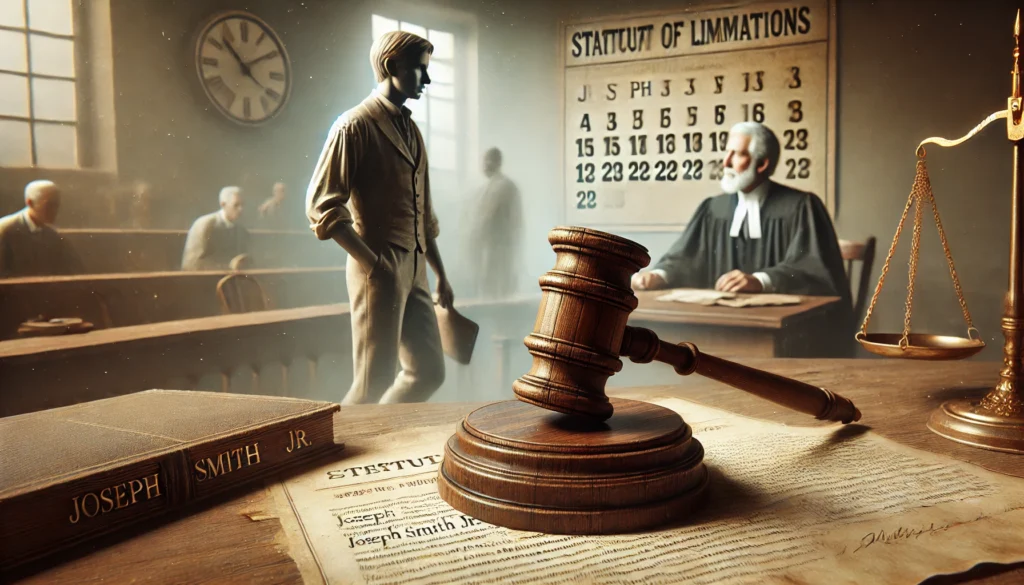
Joseph Smith the 1826 Trial and the Folk Magic Origins of Mormonism
Part I: The Culture of the Glass Looker
For decades, LDS historians denied that Joseph Smith Jr. ever stood trial for treasure seeking. The denial was not quiet. Hugh Nibley, the Church’s most prominent mid-century apologist, went on record declaring that an authentic 1826 court record would be ‘the most damning evidence in existence against Joseph Smith.’[1] The institutional position held that accounts of the trial were fabrications circulated by enemies of the faith, men like Philastus Hurlbut, who collected anti-Mormon affidavits in the early 1830s.
That position is no longer tenable. The modern LDS apologetic organization FAIR now openly acknowledges the Smith family’s treasure-seeking activities, framing ‘money digging’ as a common practice in 19th-century frontier life.[2] The concession is accurate as far as it goes. Newspaper accounts from the 1820s confirm that searching for buried treasure with ‘mineral stones’ was a documented phenomenon across upstate New York and western New England. The problem is the legal dimension, which the normalization argument skirts entirely.
New York State law did not treat glass looking as a cultural curiosity. The 1813 statute on disorderly persons specifically targeted those who used supernatural claims to extract money from others, categorizing seer stone divination as a misdemeanor.[3] Joseph Smith was not operating in a legal gray area. He was charging fees for supernatural services in a jurisdiction where that practice was a criminal offense.
The family context matters. Lucy Mack Smith’s memoirs describe the household’s use of divining rods and ritual practices in language that suggests these were ordinary features of domestic life, not anomalies.[4] Magic and religion were not competing systems in the Smith home. They were the same system.
Part II: The 1825 Spanish Treasure Expedition
The immediate catalyst for Smith’s legal trouble was Josiah Stowell. In October 1825, Stowell—a prosperous farmer who believed firmly in Smith’s supernatural gifts—hired the young Joseph to locate a legendary Spanish silver mine in Harmony, Pennsylvania. This was a formal business arrangement, not a casual outing. Joseph Jr., his father, and several laborers signed a contract entitling them to shares of any silver found.[5]
The operation had a clear division of labor. According to Isaac Hale—Joseph’s future father-in-law, who observed the proceedings—Smith directed the digging from above using his seer stone but never physically entered the pit himself.[6] When the group reached twenty feet without striking silver, Smith announced that the treasure was ‘enchanted’ and had moved. This explanation was standard within the folk magic tradition; a treasure guarded by spirits could always be said to have slipped away at the critical moment, preserving the scryer’s reputation against physical failure.
Witnesses described the site in terms drawn from ritual magic: protective circles drawn around the excavation, prayers recited against malevolent spirits, and accusations—which Quinn documents were circulating among the laborers—of blood sacrifice as a means of appeasing the guardians of the treasure.[7] The scene was less a mining operation than a séance conducted underground. Isaac Hale recorded that Smith eventually claimed ‘the enchantment was so powerful that he could not see,’ at which point the group dispersed.
Smith had read the situation correctly. The workers were losing patience. By claiming supernatural interference rather than personal failure, he preserved the possibility of future employment while exiting an expedition that was going nowhere.
Part III: The 1826 Trial and the Court Records
Peter Bridgeman broke the arrangement. Stowell’s nephew by marriage, Bridgeman watched his uncle hand over money and labor to a young man with a stone, and he filed a formal complaint. In early 1826, Joseph Smith was arrested in South Bainbridge, New York, and charged as a ‘disorderly person’ and an ‘imposter’—the official designation on the court documents was ‘Joseph Smith the Glass Looker.’
The LDS Church contested the existence of this trial for over a century. The denial collapsed in 1971 when researcher Wesley P. Walters found the actual court records in the basement of the Chenango County jail.[8] Two documents proved the trial’s reality. Justice Albert Neely’s bill, totaling $2.68, itemized the warrant, oaths from seven witnesses, a mittimus, and associated court fees.[9] Constable Philip De Zeng’s separate bill, totaling $7.50, logged the arrest on March 19, 1826, and two days’ attendance with the prisoner.[10]
These are not narrative accounts subject to memory or bias. They are financial records. Their mundane precision—the mileage charged, the per-oath rate, the overnight custody fee—makes them difficult to dismiss as forgeries. FAIR and related apologists have attempted to dispute the guilty verdict, but the Joseph Smith Papers website itself acknowledges that Neely’s docket entry concludes with the words ‘the Court finds the Defendant guilty.’[11]
Smith was not imprisoned. Contemporary accounts from A.W. Benton and Justice Joel K. Noble indicate that he was ‘designedly allowed to escape’ or, as Noble put it, ‘took leg bail’—meaning he left the county before any sentence could be enforced.[12][13] His youth appears to have worked in his favor. The machinery of justice let him walk.
Part IV: The Testimony Record
The trial transcriptions do not survive in the original. They come down through William D. Purple, who was present at the proceedings as a young associate of Justice Neely and recorded the testimony from memory in a letter published decades later, and through an 1873 article in Fraser’s Magazine that drew on documents then in circulation.[14][15] Secondary survival does not make them worthless; it makes them corroborating witnesses, not primary evidence.
Under oath, Smith admitted to possessing a stone he used to ‘determine where hidden treasures in the bowels of the earth were.’ Josiah Stowell testified in Smith’s defense with striking conviction, telling the court he ‘positively knew’ that Smith could see buried treasure through the stone. Stowell’s loyalty to his seer was absolute even after the Pennsylvania expedition had produced nothing.
Jonathan Thompson, another witness, described the moment when the excavation group believed they had struck a chest, only to watch it sink deeper into the mud. Thompson’s explanation was enchantment—the treasure had been driven down by a spell at the moment of discovery.[16] He insisted that Smith had accurately located the object. The failure to retrieve it was the spirits’ doing, not the scryer’s.
These testimonies reveal the internal logic of the folk magic culture with precision. Within that logic, every failed excavation confirmed rather than refuted the scryer’s abilities. The treasure moved because the spirits were powerful; it existed because the seer had seen it. Failure was always externalized. The stone was never wrong.
Conclusion
The 1826 trial records did not damage Mormon history. They clarified it. The trial transformed ‘money digging’ from an allegation traded among critics into a documented legal fact, establishing that Joseph Smith operated as a professional seer—accepting payment for supernatural services—years before he produced the Book of Mormon.
Richard Bushman, writing as a believing historian in Rough Stone Rolling, acknowledges the direct continuity between the seer stone used in treasure-seeking and the stone used in the Book of Mormon translation process.[17] This is not a peripheral detail. It means the same instrument, and arguably the same performance framework, carried over from the glass-looking trade into the founding revelations of a new religion.
The institutional reversal on this history has been complete. FAIR now states explicitly that ‘the evidence strongly suggests Joseph and members of his family were involved in the folk magic culture of their day’[18]—a sentence that would have been unthinkable in Nibley’s era, when that same acknowledgment was declared the most damning evidence imaginable. The evidence did not change. The Church’s capacity to absorb it did.
Hugh Nibley was right about one thing. The 1826 trial record is powerful evidence. It anchors the origins of Mormonism not in a clean break from the folk magic world but in its direct continuation—a young scryer who traded his stone for scripture and built a religion on the credibility he had spent years performing.
[1]Hugh Nibley, No, Ma’am, That’s Not History (Salt Lake City: Bookcraft, 1946), 46. Nibley made the statement in a direct challenge to critics who were then circulating unverified trial accounts.
[2]FAIR (Faithful Answers, Informed Response), ‘Joseph Smith and Money-Digging,’ accessed 2024, https://www.fairlatterdaysaints.org. The organization now acknowledges treasure-seeking as a documented aspect of Joseph Smith’s early life.
[3]New York State Laws, 38th Session, ch. 88 (1813). The statute defined ‘disorderly persons’ to include ‘jugglers’ and those who ‘pretend to have skill in physiognomy, palmistry, or like crafty science, or pretend to tell fortunes, or to discover where lost goods may be found.’ See also D. Michael Quinn, Early Mormonism and the Magic World View, rev. ed. (Salt Lake City: Signature Books, 1998), 37–41.
[4]Lucy Mack Smith, Biographical Sketches of Joseph Smith the Prophet (Liverpool: S. W. Richards, 1853), 37–38. Lucy’s account describes family participation in divining rods and treasure-seeking rituals in the early 1820s, though she frames these as spiritually inspired rather than fraudulent.
[5]The contract document is reproduced and analyzed in Dean C. Jessee, ed., The Papers of Joseph Smith, vol. 1 (Salt Lake City: Deseret Book, 1989), 639–40. For arguments in favor of its authenticity, see Mark Ashurst-McGee, ‘A Pathway to Prophethood: Joseph Smith Junior as Rodsman, Village Seer, and Judeo-Christian Prophet’ (MA thesis, Utah State University, 2000), 141–46.
[6]Isaac Hale’s affidavit, dated March 20, 1834, is reprinted in Eber D. Howe, Mormonism Unvailed (Painesville, OH: Telegraph Press, 1834), 262–66. Hale describes Smith directing digging from above the pit while consulting his stone.
[7]Quinn, Early Mormonism and the Magic World View, 52–58. Quinn documents the specific ritual practices associated with treasure-seeking in the Burned-over District, including the drawing of protective circles and the use of blood sacrifice as reported by multiple contemporaneous witnesses.
[8]Wesley P. Walters, ‘Joseph Smith’s Bainbridge, N.Y., Court Trials,’ Westminster Theological Journal 36, no. 2 (1974): 123–55. Walters describes the physical discovery of the court records in the jail basement and provides facsimiles of both bills.
[9]The bills are reproduced in full in Walters, ‘Joseph Smith’s Bainbridge, N.Y., Court Trials,’ 125–27. Justice Neely’s bill itemizes: warrant, $0.19; seven oaths at $0.25 each ($1.75); recognizances; mittimus; and court fees totaling $2.68.
[10]Constable Philip De Zeng’s bill records ‘travel to Neighbour Stowell in Company with Joseph Smith the glass looker—going and returning 18 miles,’ dated March 19, 1826. Reproduced in Walters, ‘Joseph Smith’s Bainbridge, N.Y., Court Trials,’ 127.
[11]The verdict entry from Neely’s docket reads: ‘And therefore the Court finds the Defendant guilty.’ The Joseph Smith Papers Project acknowledges this language at josephsmithpapers.org, ‘Justice Albert Neely Bill, March 1826.’
[12]A.W. Benton, ‘Mormonism,’ Evangelical Magazine and Gospel Advocate, April 9, 1831. Benton was among the first to publish an account of the 1826 trial, noting that Smith ‘was condemned’ but subsequently allowed to leave the county.
[13]Joel K. Noble to Jonathan B. Turner, March 8, 1842, reprinted in Rodger I. Anderson, Joseph Smith’s New York Reputation Reexamined (Salt Lake City: Signature Books, 1990), 131–35. Noble, who presided over a subsequent 1830 trial involving Smith, recorded the 1826 outcome from direct local knowledge.
[14]William D. Purple’s account first appeared in the Chenango Union, May 2, 1877. Purple was present at the 1826 proceedings as a young associate of Justice Neely and recorded detailed testimony from memory. His account is reprinted in Francis W. Kirkham, A New Witness for Christ in America, vol. 2 (Salt Lake City: Utah Printing Co., 1959), 362–64.
[15]‘A Glance at the Mormons,’ Fraser’s Magazine for Town and Country 87 (February 1873): 229–38. The article reproduces trial testimony attributed to multiple witnesses, including Stowell and Thompson, drawing on documents then in circulation among anti-Mormon correspondents.
[16]Jonathan Thompson’s testimony is preserved in the Fraser’s Magazine account (1873) and corroborated in substance by Purple (1877). Both sources record Thompson’s insistence that the box sank due to enchantment, despite the group’s failure to retrieve it.
[17]For the broader trajectory from scryer to prophet, see Richard L. Bushman, Joseph Smith: Rough Stone Rolling (New York: Knopf, 2005), 50–52. Bushman, writing as a believing historian, acknowledges the continuity between the seer stone used in treasure-seeking and the one used in dictating the Book of Mormon.
[18]The FAIR entry on ‘Joseph Smith and Money-Digging’ states explicitly that ‘the evidence strongly suggests Joseph and members of his family were involved in the folk magic culture of their day.’ This represents a complete reversal from the institutional position maintained from the Nibley era through the mid-twentieth century.