
Academic Papers & Essays
Browse a growing library of accessible scholarship on Mormonism, Islam, Second Temple Judaism, Early Christianity, and other religious traditions.

Language, Title, Territory, and Ritual: The Systematic Theological Construction of Early Mormonism
This essay presents a forensic investigation into the 1832 “Sample of Pure Language” as a functional nomenclature for early Mormon administrative theology. Rather than a mere linguistic restorative effort, the Adamic nomenclature (Awmen, Son Awman, Angls-men) is analyzed as a technical specification for the hierarchical organization of the “Sod” (Divine Council) and its terrestrial manifestation.

Institutional Retreat and Evidentiary Management: The LDS Gospel Topics Essay on DNA and the Book of Mormon
This study analyzes the The Church of Jesus Christ of Latter-day Saints Gospel Topics Essay “Book of Mormon and DNA Studies” as a work of institutional rhetoric rather than scientific inquiry. It argues that the essay functions as a strategy of evidentiary management developed in response to population genetics research demonstrating that Native American ancestry derives overwhelmingly from ancient Siberian and East Asian populations, with no detectable Near Eastern genetic contribution.

Defending the Indefensible? An Academic Examination of Latter-day Saint Apologist Arguments Concerning the Book of Abraham, the Kirtland Egyptian Papers, and the Long Scroll Theory
This paper undertakes a systematic critical examination of the principal apologetic arguments advanced by Latter-day Saint scholars-most prominently John Gee (BYU Egyptologist) and Kerry Milstein (BYU Egyptologist and ancient Near East specialist)-in defense of the Book of Abraham as an authentic ancient text. Drawing on the documentary record of the Kirtland.

A Stable Textual Tradition: Manuscript Evidence, Chain of Custody, and the Provenance of Doctrine and Covenants Section 132
This study reframes Doctrine and Covenants Section 132 not as a purely theological artifact but as a document within a recoverable manuscript tradition, demonstrating that methods typically applied to ancient texts can yield meaningful results when applied to modern religious sources. Employing textual criticism, source stratification, independence of attestation, and chain-of-custody analysis, this paper argues that the documentary record reflects a stable textual tradition originating with Joseph Smith in July 1843 and that claims of posthumous alteration under Brigham Young.

The Editor as Author: A Forensic Critique of Stephen Smoot’s “Latter-day Targumist” Thesis
This paper evaluates Stephen O. Smoot’s claim that Joseph Smith’s Joseph Smith Translation (JST) can be meaningfully understood within a Targumic framework. It argues that the comparison fails at the structural level.

Were Abraham and Moses Historical
Dust rises over the ancient city of Ur. Towering ziggurats pierce the Mesopotamian sky, their mudbrick faces baking under a relentless sun. Markets pulse with merchants trading textiles and grain while priests tend temples dedicated to a vast pantheon of gods. It is within this deeply polytheistic world that a single figure-Abram-steps forward in biblical tradition, called to abandon everything familiar and walk into the unknown at the behest of one God.
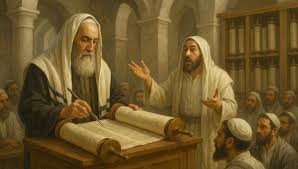
The Authorship of the Pentateuch
The Documentary Hypothesis identifies four major sources—Yahwist (J), Elohist (E), Deuteronomist (D), and Priestly (P)—whose distinct linguistic, theological, and narrative features reveal independent origins later combined by editors. Linguistic registers and vocabulary shifts corroborate this multi-period composition.

The Canaanite Crucible
For centuries, the question of where the ancient Israelites actually came from was a fight between two camps: the biblical text and the archaeologist’s spade. The Bible offered a grand narrative-slaves escaping Egypt, forty years in the desert, a promised land seized by force. Archaeology, as it matured through the 20th century, grew increasingly skeptical.

Reassessing the Date of 1 Clement: Implications for Early Christian Belief About Jesus
The dating of early Christian texts directly impacts our understanding of the origins and beliefs of the movement. The First Epistle of Clement, traditionally dated to the late first century (~95 CE), has been argued by a minority of scholars, most notably Richard Carrier, to originate in the 60s CE. This study reassesses both the traditional late-date and the proposed early-date arguments, examining textual, historical, and rhetorical evidence. While Carrier’s case raises interesting questions regarding the Temple, references to apostolic deaths, and the absence of explicit mentions of events such as the destruction of Jerusalem, these arguments rely on speculative assumptions and arguments from silence.

Joseph Smith the 1826 Trial and the Folk Magic Origins of Mormonism
For decades, LDS historians denied that Joseph Smith Jr. ever stood trial for treasure seeking. The denial was not quiet. Hugh Nibley, the Church’s most prominent mid-century apologist, went on record declaring that an authentic 1826 court record would be ‘the most damning evidence in existence against Joseph Smith.

Ancient Near Eastern