Were Abraham and Moses Historical?
A review of the archaeological and textual evidence — and what its silence means.
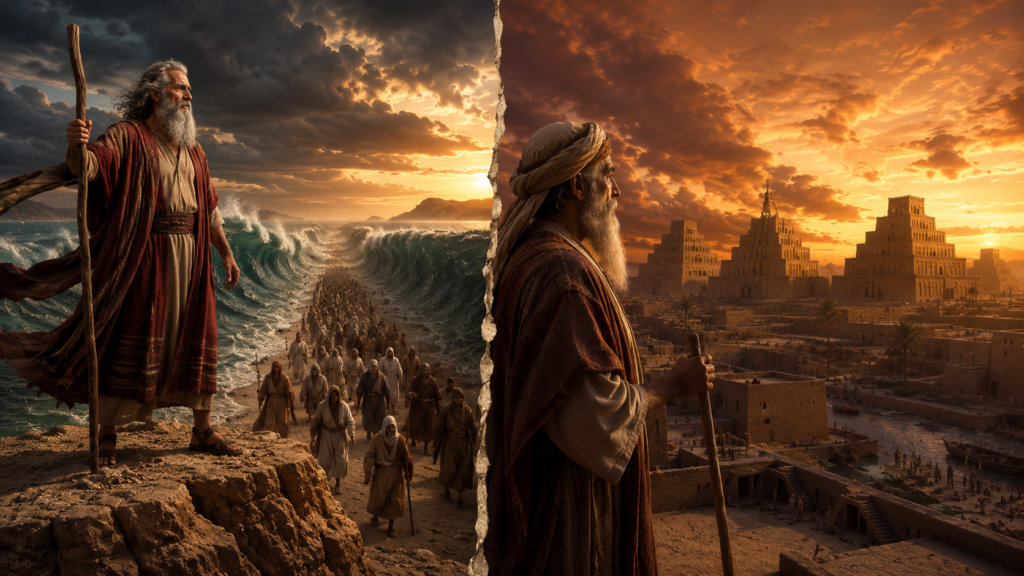
Dust rises over the ancient city of Ur. Towering ziggurats pierce the Mesopotamian sky, their mudbrick faces baking under a relentless sun. Markets pulse with merchants trading textiles and grain while priests tend temples dedicated to a vast pantheon of gods. It is within this deeply polytheistic world that a single figure — Abram — steps forward in biblical tradition, called to abandon everything familiar and walk into the unknown at the behest of one God.
Centuries later, another story unfolds along the Nile. A child pulled from the reeds and raised in Pharaoh’s palace grows into a man who will confront the most powerful empire of his age. Moses — lawgiver, liberator, the prophet who speaks with God face to face — leads his people through plague, sea, and wilderness to the edge of the Promised Land.
These stories have shaped three world religions, inspired liberation movements across centuries, and formed the moral imagination of billions of people. They have also attracted more serious scholarly scrutiny than almost any other narratives in human history. When you strip away the tradition and examine what archaeology, textual criticism, and ancient Near Eastern scholarship actually show, the question of whether either man existed becomes far more difficult — and far more interesting — than popular culture tends to acknowledge.
The short answer is that no direct, independently corroborated archaeological or historical evidence has yet confirmed the existence of Abraham or Moses as described in the Bible. What we have instead are rich, purposefully constructed narratives — written centuries after the events they describe — that served specific ideological and theological functions for the communities that produced them. That conclusion does not settle every debate; serious scholars continue to disagree sharply about exactly what it implies. But it is the starting point any honest inquiry must accept.
Part I — Abraham: patriarch or literary construction?
Abraham occupies the theological foundation of Judaism, Christianity, and Islam. According to Genesis, he lived somewhere in the Middle Bronze Age, broadly between 2000 and 1800 BCE, and originated from Ur of the Chaldees in southern Mesopotamia before migrating through Haran into Canaan. Archaeology confirms that Ur was a genuine major urban center during this period. Excavations have revealed its famous ziggurat, evidence of extensive trade networks, and a sophisticated religious culture. The environmental setting of Genesis is, in that sense, plausible.
Plausibility is not the same as evidence.
Despite more than a century of excavation in Mesopotamia, Syria, and Canaan, no inscription, administrative document, or material artifact has ever mentioned Abraham by name. This absence deserves emphasis. The ancient Near East was a heavily literate civilization. Egypt and Mesopotamia both produced enormous bodies of written material — royal annals, temple records, merchant correspondence, treaties, legal codes. The Ebla archive in Syria alone yielded around 17,000 tablets from the third millennium BCE. If Abraham had been a significant tribal leader or covenant-making patriarch, the probability of at least some trace of him surviving in this documentary record, while not certain, is meaningfully higher than zero. The record is silent.
American archaeologist William G. Dever — not a theological minimalist but a scholar who has spent his career defending a historical core to much of the Hebrew Bible — concluded that the patriarchal narratives are best understood as origin stories composed to explain Israel’s beginnings rather than as records of actual individuals.[1] Dever’s position is worth noting precisely because he resists the “minimalist” school that dismisses the Bible as wholesale invention. Even from that centrist scholarly position, Abraham as a historical individual does not survive scrutiny.
“The biblical narratives are indeed ‘stories,’ often fictional and almost always propagandistic.” — William G. Dever
Israel Finkelstein of Tel Aviv University — one of the more provocative figures in the field, and the co-author of The Bible Unearthed — pushed the argument further.[2] In his reading, the patriarchal narratives were composed or compiled during the late monarchic period, particularly in the seventh and sixth centuries BCE, when Judah faced existential pressure from Assyria and Babylon. The stories of Abraham, Isaac, and Jacob in this view function as ideological literature: they create a shared ancestry, unify diverse tribal groups under a common origin, and establish a theological framework centered on covenant and divine promise. History, in that context, is a tool for identity formation, not reportage.
The cultural details in the Abraham narratives — nomadic herding, patterns of migration, kinship structures, covenantal practices — are consistent with what we know of the broader ancient Near Eastern world. But consistency is not confirmation. A skilled writer in seventh-century Judah had access to oral traditions and living cultural knowledge that could have supplied precisely these details without any eyewitness chain connecting them to the Bronze Age.
Abraham in Egypt
One of the more telling episodes in Abraham’s story involves a journey to Egypt during a famine. According to Genesis, Abraham fears that his wife Sarah’s beauty will get him killed, so he presents her as his sister. Pharaoh takes Sarah into his household, suffers divine plagues, and then expels the couple — enriched with gifts. This is a dramatic narrative. Egypt is also one of the best-documented civilizations in world history, with scribal traditions stretching across two thousand years of continuous record-keeping covering royal events, administrative transactions, foreign visitors, and religious disturbances. No Egyptian source mentions Abraham, Sarah, or any incident resembling this account. The complete absence of corroboration suggests the episode is theological in purpose rather than historical in origin — it establishes divine protection, the covenant’s special status, and Abraham’s favored position, and it does all of this by borrowing the prestige of Egypt as a backdrop.
Some scholars propose that Abraham represents a composite figure — a symbolic ancestor who embodies the collective memory of various Semitic groups that eventually merged into what became Israel. There may be faint echoes of genuine ancient migrations within the narrative: movement from Mesopotamia to Canaan does reflect known patterns of Bronze Age mobility. But those echoes have been shaped and reinterpreted through centuries of oral transmission and editorial revision. The result is a figure who feels historically grounded yet remains historically inaccessible. Abraham functions as a bridge between origins and identity. Whether he existed as an individual is, for the biblical authors, beside the point — which is itself revealing.
Part II — Moses: liberator or legend?
If Abraham is Israel’s genesis, Moses is its defining crisis. He confronts Pharaoh, summons ten plagues upon Egypt, parts a sea, and at the summit of Sinai receives the law that will shape Western civilization for three thousand years. The story has functioned as a template for liberation movements from the American Revolution to the civil rights era. Frederick Douglass explicitly compared his own escape from slavery to the Exodus. Martin Luther King Jr. invoked it in his final speech. The narrative’s power is beyond dispute.
Its historical credibility is another matter.
The silence of Egypt
Egypt kept extraordinary administrative records. Pharaohs commissioned inscriptions of their military campaigns, their building projects, their religious ceremonies. Commercial transactions were recorded on papyri, letters between officials survive from Amarna, and the Merneptah Stele — dated to around 1208 BCE — contains the earliest extrabiblical reference to “Israel” as a people in Canaan. Egyptian record-keeping was not perfect, and pharaohs were not inclined to publicize their defeats. But the absolute silence on Moses, on the enslavement of a large Hebrew population, on ten catastrophic plagues, and on the sudden departure of hundreds of thousands of people from the eastern Delta is not simply suspicious — it is a fundamental problem for the Exodus narrative’s historical credibility.
Egyptian sources do confirm the presence of Semitic peoples in the Nile Delta, particularly during periods such as the Hyksos occupation (roughly 1650–1550 BCE), when a Semitic dynasty controlled Lower Egypt from their capital at Avaris (modern Tell el-Dabʻa).[3] Some scholars have suggested that collective memories of the Hyksos expulsion may have seeded what eventually became the Exodus story. It is a possibility worth taking seriously. But the Hyksos were not enslaved — they were rulers, and they were expelled rather than fleeing. The fit between the archaeological evidence and the biblical narrative is loose at best.
The archaeology of the Exodus route
Exodus 12:37–38 states that roughly 600,000 Israelite men left Egypt, which together with women, children, and the elderly implies a migrating population of two million or more. Numbers 1:46 gives a more precise figure of 603,550 fighting men. Such a movement through the Sinai Peninsula over forty years would be expected to leave a substantial archaeological footprint — campsites, pottery, tools, refuse deposits, graves. Extensive surveys of the Sinai have found none of it.[4]
The site of Kadesh-Barnea, where the Israelites are said to have spent thirty-eight years, was archaeologically uninhabited during the relevant period of the second millennium BCE. The broader picture of early Israelite settlement in Canaan, revealed by decades of highland excavation, shows communities that grew gradually and organically from local Canaanite roots — the pottery is Canaanite, the cult objects are Canaanite, the settlement patterns show no intrusive population arriving from outside.[5] Even Dever, who argues for a historical core to the Israelite monarchy, concluded in a 2013 lecture that the Exodus as described is largely “pseudo-history,” and that the early Israelites were mostly indigenous Canaanites, while allowing that a smaller group — perhaps a few thousand, possibly Levites with genuine Egyptian connections — may have joined Israel in the thirteenth century BCE.[6]
The majority of archaeologists have abandoned the search for a historical Exodus, in the phrase used by Dever, as “a fruitless pursuit.”
Moses and Midian — a clue about Yahweh’s origins
One of the more genuinely interesting threads in the Moses narrative is its connection to Midian. After fleeing Egypt, Moses settles among a Midianite clan, marries Zipporah, the daughter of a priest named Jethro (or Reuel), and encounters God for the first time at the burning bush on Mount Horeb. This detail has attracted serious scholarly attention. A body of scholarship — associated with what is sometimes called the Kenite Hypothesis — proposes that worship of Yahweh may have originated not in Canaan but among Midianite or Kenite tribes in the southern Sinai and northwestern Arabia.[7] In this reading, Moses becomes a cultural intermediary: the figure through whom a southern desert deity was introduced into Israelite religion. The hypothesis is contested. But it illustrates how the Moses narrative, even if not historically verifiable, preserves what may be genuine traces of how early Israelite religion was constructed from diverse and geographically scattered sources.
Who wrote the Torah?
Traditional Jewish and Christian belief holds that Moses authored the Torah — the first five books of the Bible. The text resists this claim almost immediately. Deuteronomy 34 describes Moses’s death and burial, notes that no one knows the location of his grave to “this day,” and praises him as a prophet whom God knew “face to face” — all of it written about Moses in the third person. Whatever one makes of this, Moses could not have written his own obituary.
Modern textual scholarship does not simply reject Mosaic authorship and leave a vacuum. The Documentary Hypothesis — formalized by Julius Wellhausen in the late nineteenth century, building on earlier work by scholars including Karl Heinrich Graf and Hermann Hupfeld — identifies four major source traditions within the Torah, conventionally labeled J (Yahwist), E (Elohist), D (Deuteronomist), and P (Priestly).[8] Each carries its own theological emphasis, geographic interests, and characteristic vocabulary. J uses the divine name YHWH, reflects southern Judahite concerns, and is responsible for much of Genesis. E uses “Elohim” until the divine name is revealed to Moses in Exodus 3, and appears to reflect northern Israelite traditions. D produced the core of Deuteronomy and is closely associated with the law-code discovered in Jerusalem during King Josiah’s reign around 622 BCE. P supplied the creation account that opens Genesis, most of Leviticus, and extensive genealogical material, and represents a priestly tradition probably active both before and during the Babylonian exile.
The classical Wellhausian dating has been modified and challenged by later scholars — John Van Seters, Rolf Rendtorff, and others in the 1970s argued that J should be dated later, to the Babylonian period, and questioned whether a substantial independent E source existed at all.[9] Contemporary scholarship tends to see the completed Torah as a product of the Persian period, roughly 450–350 BCE, though some D and P materials are clearly earlier. What virtually all critical scholars agree on is the basic fact: the Torah as we have it is not the product of a single author, let alone Moses. It is a composite work assembled from multiple traditions over several centuries. The Moses who strides through those pages is himself a constructed figure — a theological hero shaped by generations of storytelling, priestly editing, and national memory.
A historical core?
Not all scholars dismiss Moses entirely. Richard Elliott Friedman, in his work on Exodus and the Levites, argues that the Egyptian names among the tribe of Levi — Moses, Phinehas, Hophni, Hur — are difficult to explain unless a group with genuine Egyptian connections stood at the origin of the Levitical tradition.[10] In this reconstruction, Moses could have been a real individual associated with a smaller group, probably Levites, who did leave Egypt and whose experience later expanded into the national narrative of the Exodus. The Moses of history, if he existed at all, was almost certainly a far more modest figure than the Moses of the text. His story was then absorbed into a much larger national myth during the process of state formation and theological consolidation in the Iron Age.
Egyptologist Kenneth Kitchen, one of the more robust defenders of the Bible’s general historical reliability, acknowledges the absence of direct Egyptian evidence but argues that pharaohs routinely suppressed records of their failures — a real practice, documented in other contexts, including the erasure of Akhenaten’s name from monuments after his death.[11] The argument has some force, but it cannot explain away the complete archaeological silence across the Sinai, or the material evidence that early Israelite culture was Canaanite rather than Egyptian in character.
Part III — What the silence means
Absence of evidence is not, in a strict philosophical sense, evidence of absence. Archaeology recovers only what survived, what was excavated, and what has been correctly interpreted. Ancient nomadic populations leave thin archaeological traces. Pharaohs did suppress unflattering records. The Nile Delta floods regularly, destroying documents and built structures. These are legitimate cautions, and scholars who raise them are not simply being credulous.
But the scale of the silence in this case matters. We are not talking about a missing clay tablet or an unexcavated site. We are talking about the complete absence of corroboration for a population of millions of enslaved people, ten divine catastrophes severe enough to devastate the most organized administrative state in the ancient world, forty years of occupation of a peninsula that has been extensively surveyed, and a mass migration that would rank among the largest demographic events in Bronze Age history. Egypt documented far less dramatic events with considerable care. The silence is not a gap — it is a pattern.
The honest conclusion is that the Abraham and Moses of the Bible — the patriarchal founder of a covenant people, the miracle-working prophet who confronts Pharaoh and receives the law at Sinai — are not figures we can locate in the historical record. They are figures located in narrative: in origin stories crafted by communities under political pressure, trying to explain who they were, where their God came from, and why they mattered.
That conclusion does not diminish the stories. The influence of both figures on human history is staggering. The covenant theology embedded in the Abraham narratives shaped Jewish, Christian, and Islamic ideas about the relationship between God and humanity for three millennia. The Exodus story became one of the most powerful political metaphors in Western civilization — a resource for every generation that has needed language for oppression and liberation. Stories do not have to be historically factual to be historically consequential. In this case, the narratives have arguably done more work in the world than any individual historical figure could have done.
What the archaeological record asks us to accept is more complex than simple belief or simple skepticism. Abraham may carry within him the compressed memory of ancient Semitic migrations into Canaan, mythologized into a single patriarchal figure. Moses may encode genuine historical knowledge about a southern deity, a priestly clan with Egyptian connections, and the experience of forced labor in the Delta — all of it processed through centuries of national storytelling into a singular hero. Both figures stand at the boundary between history and imagination, a boundary that ancient peoples did not draw the way we do, and that the Hebrew Bible never pretended to draw at all.
They are not found in the sands.
They are found in the story of who a people decided to be.
[1]William G. Dever, What Did the Biblical Writers Know and When Did They Know It? (Grand Rapids, MI: Eerdmans, 2001), 98–104. Dever’s position is summarized in his lecture catalog entry at the Biblical Archaeology Society.
[2]Israel Finkelstein and Neil Asher Silberman, The Bible Unearthed: Archaeology’s New Vision of Ancient Israel and the Origin of Its Sacred Texts (New York: Free Press, 2001), 27–47.
[3]On Hyksos archaeology at Avaris, see Manfred Bietak, “Avaris, Capital of the Hyksos Kingdom: New Results of Excavations,” in The Hyksos: New Historical and Archaeological Perspectives, ed. Eliezer D. Oren (Philadelphia: University Museum, University of Pennsylvania, 1997), 87–139.
[4]Finkelstein and Silberman, The Bible Unearthed, 62–63. On the specific absence of occupation at Kadesh-Barnea, see Rudolph Cohen, “Kadesh-Barnea: A Major Fortress in the Negev,” Biblical Archaeology Review 7, no. 3 (1981): 42–58.
[5]Finkelstein and Silberman, The Bible Unearthed, 107–18. See also William G. Dever, Who Were the Early Israelites and Where Did They Come From? (Grand Rapids, MI: Eerdmans, 2003), 181–200.
[6]William G. Dever, “Archaeology and the Exodus,” lecture (2013), cited in “William G. Dever,” Wikipedia, last modified December 20, 2025.
[7]On the Kenite Hypothesis see Frank Moore Cross, Canaanite Myth and Hebrew Epic: Essays in the History of the Religion of Israel (Cambridge, MA: Harvard University Press, 1973), 60–75. See also John Day, Yahweh and the Gods and Goddesses of Canaan (Sheffield: Sheffield Academic Press, 2000), 13–15.
[8]Julius Wellhausen, Prolegomena to the History of Israel, trans. J. Sutherland Black and Allan Menzies (Edinburgh: Adam & Charles Black, 1885; orig. German 1878). For a standard overview see Richard Elliott Friedman, Who Wrote the Bible? (New York: Harper & Row, 1987), 15–60.
[9]On post-Wellhausian revisions see John Van Seters, Abraham in History and Tradition (New Haven: Yale University Press, 1975); Rolf Rendtorff, The Problem of the Process of Transmission in the Pentateuch, trans. John J. Scullion (Sheffield: JSOT Press, 1990). On Persian-period dating see “Documentary Hypothesis,” Wikipedia, last modified February 4, 2026.
[10]Richard Elliott Friedman, “The Exodus Is Not Fiction,” Reform Judaism (Spring 2014). Friedman develops the Levite argument at greater length in The Exodus: How It Happened and Why It Matters (New York: HarperOne, 2017).
[11]Kenneth A. Kitchen, On the Reliability of the Old Testament (Grand Rapids, MI: Eerdmans, 2003), 246–250.