
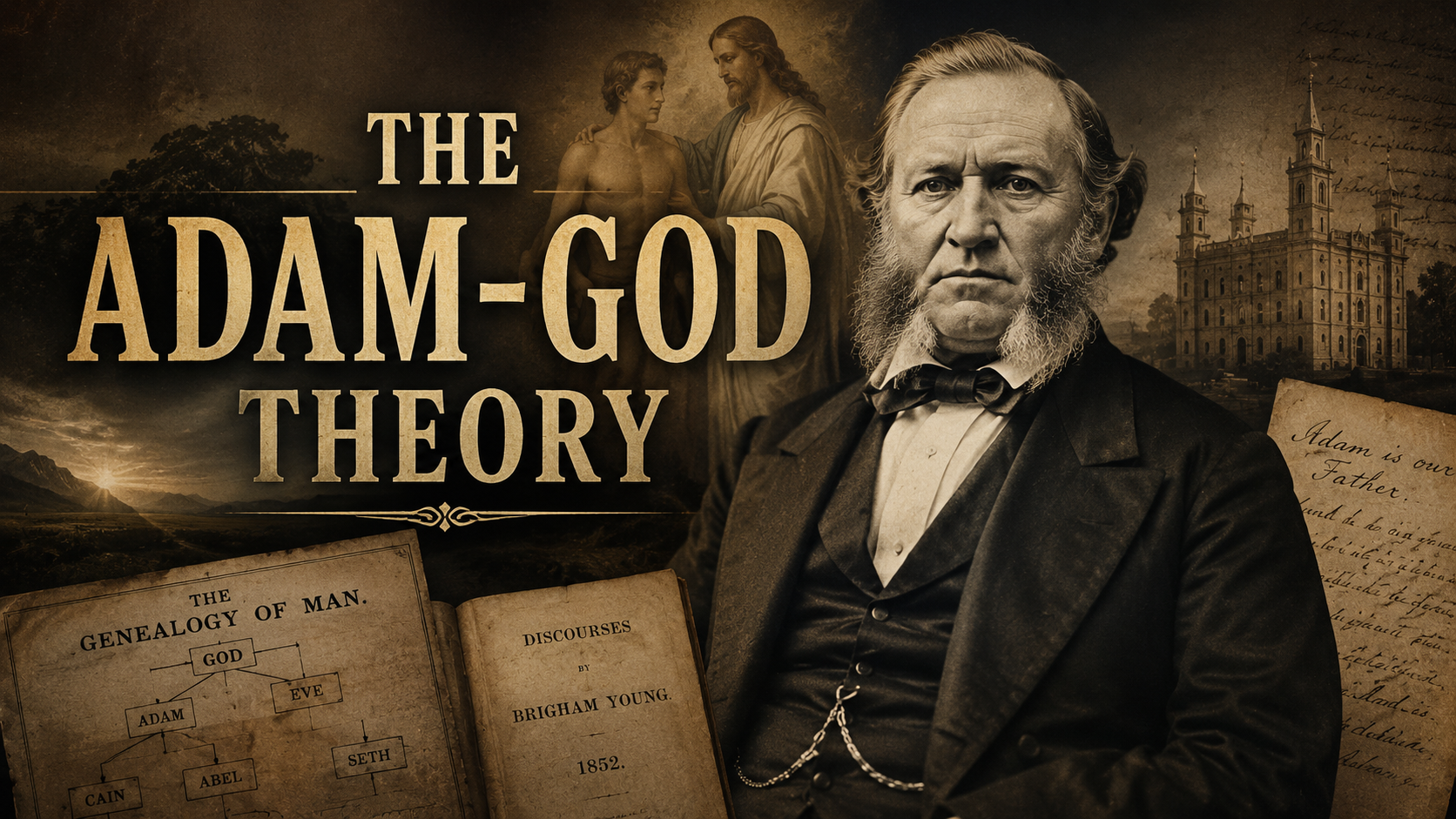
The Adam-God Theory
The Adam-God theory is one of the most controversial teachings ever associated with the Church — a doctrine many members today have never heard of, or know only as a name spoken in hushed tones.
In 1861, Brigham Young addressed members who struggled with his teaching that Adam was both their father and their God. He told them plainly that the idea would be a curse to many of the Elders of Israel because of their own foolishness, and that those who scoffed at it were as ignorant as a dumb animal. He called it one of the most glorious truths ever revealed about heaven’s plan, even as the world treated it with derision.1
The Church’s own apologetics organization, FAIR, offers a measured defense: that Young clearly believed and taught the idea, but never fully reconciled it with scripture or elevated it to official doctrine — and that modern leaders have cautioned against accepting popular explanations of it. Since the Church has since rejected the teaching, FAIR argues, the matter simply awaits further revelation.2
That defense raises an obvious question. How does an institution reject the teaching of a man its members revere as a prophet, seer, and revelator? The doctrine mattered enough to Brigham Young that he wove it into the temple endowment ceremony, where it remained from the late 1800s into the early 1900s. A teaching significant enough to anchor decades of sacred temple ritual is not easily waved away.
So what exactly was the Adam-God doctrine, and where did it come from?
The Doctrine Itself
As taught, Adam was once a mortal man on another world who was resurrected and exalted to godhood. Known there as Michael, he came to organize and form the Earth. He took on a physical body, took Eve as his wife, and became mortal himself by eating the forbidden fruit in Eden. After fathering the human race, Adam and Eve returned to their heavenly thrones — Adam now serving as God and Heavenly Father to humankind. Later, the teaching held, Adam returned to Earth to visit ancient prophets, and was the literal father of Jesus Christ.
The idea startled people when it surfaced, and it never stopped being controversial, even inside the Church. Apostle Orson Pratt was its most prominent opponent, and the Bunker family among others openly resisted it as well — both facing real threats of ecclesiastical discipline for speaking out. Yet the doctrine outlived Brigham Young’s own presidency. His successor, John Taylor, privately affirmed his belief in it before his death in 1887.
Did It Originate with Joseph Smith?
Young always insisted the teaching did not begin with him, but with Joseph Smith. Believers point to several of Smith’s own statements as the seed of the idea. In an 1839 sermon, Smith taught that Adam was the archangel Michael, who had held the First Presidency in the premortal life and who carries “the keys of the universe” — meaning that every priesthood key given from heaven passes through his authority. In 1840, Smith said Adam was the one “through whom Christ has been revealed from heaven, and will continue to be revealed from henceforth.” And in his famous 1844 King Follett discourse, Smith taught that God himself was once a man, “like one of us.”
Young and others claimed Smith taught them the fuller doctrine privately before his 1844 death. Most historians today take a different view: that Young and his colleagues built an elaborate theological structure on top of Smith’s much vaguer remarks about Adam’s special status. While Young is usually credited as the doctrine’s architect, his counselor in the First Presidency, Heber C. Kimball, may have shaped it as well.
Young’s First Public Declaration
Young first introduced the doctrine by name at the 1852 General Conference. He told the assembly that the identity of the father of Jesus had remained a mystery in the Church until that day — and then resolved the mystery himself: Adam, he said, came into Eden already possessing a celestial body, bringing Eve, one of his wives, with him. Adam had helped organize the world. He was Michael the Archangel, the Ancient of Days, and he was, in Young’s words, humanity’s Father and God — “the only God with whom we have to do.” Every person on Earth, Young declared, believer or not, would come to know this sooner or later. As for the conception of Jesus, Young taught that Mary’s child was begotten by the Father in the Father’s own likeness — not by the Holy Ghost — and identified that Father as “the first of the human family.”3
Young went on to describe “three distinct characters” — Eloheim, Yahovah, and Michael — and stated that Jesus, “our elder brother,” was begotten in the flesh by that same being who walked in the Garden of Eden and who is our Father in Heaven.
He closed with a warning as striking as the doctrine itself: that if he told the whole truth, what he had already said would seem like nothing compared to it, and that anyone hearing these teachings should pause before mocking them or treating them lightly — because, he said, they would prove to be either salvation or damnation for those who heard them.
Filling In the Details
At a special conference on August 28, 1852, Young elaborated on the mechanics of how celestial beings like Adam and Eve could produce mortal children. New gods and goddesses, he explained, first create spirit offspring, then travel to a newly formed world to eat and drink its fruits. That act infuses their celestial bodies with coarser, physical matter, allowing them to then produce mortal bodies for their spirit children. Young summarized the point bluntly: “Adam is my Father.”
He returned to the subject on February 19, 1854, and again at the October 1854 general conference, each time holding his listeners’ attention. He taught that Adam and Eve were the literal, natural parents of every spirit that comes to this planet — making all humanity brothers and sisters — and that Adam was God, humanity’s Eternal Father.
A Divided Reaction
The Mormon community’s response to the doctrine split sharply. Some saw it as prophetic revelation; others rejected or quietly reworked it to fit older beliefs.
Thomas Bullock, the conference clerk, recorded that Young delivered his 1852 sermon with “great power” under the influence of the Holy Ghost. Heber C. Kimball backed the teaching outright, stating that the God and Father of Jesus Christ was Adam. Franklin D. Richards affirmed it too, declaring in June 1854 that “the Prophet and Apostle Brigham has declared it, and that it is the word of the Lord.”
Kimball went further still in a June 29, 1856 sermon, teaching that there was only one God who pertained to this people and this earth: the first man, Adam. The doctrine even worked its way into congregational singing — the 1856 hymn “We Believe in Our God” referred to Adam as “earth’s Lord.” That hymn was later pulled from LDS hymnals. A poem from 1861, “Sons of Michael,” contained the line “Sons of Michael, he approaches! / Rise; the Eternal Father greet.” The poem survives in the current hymnal, but the wording has since been changed to “ancient father.”
The doctrine kept its standing well into the later 19th century. George Q. Cannon, a member of the First Presidency, suggested there was nothing preventing “Father Adam from visiting and overshadowing the mother of Jesus.”
FAIR’s modern response draws a clear line: whatever else is debated, the organization maintains that the popular understanding of Adam-God — that Adam, the first man, was literally identical with God the Father — has never been the doctrine of the Church. Any grain of truth within it, FAIR argues, would need to align with already-revealed scripture, and only further revelation from Church leadership could settle the remaining questions.4
It’s worth pausing on that defense. The historical record shows a church that did, in fact, teach this doctrine fervently, repeatedly, and at the highest levels of leadership for decades. Downplaying or distorting that history doesn’t change what happened. The evidence is worth examining closely.
Orson Pratt’s Opposition
Orson Pratt was the doctrine’s most outspoken internal critic, challenging it both publicly and in private meetings with fellow apostles. He laid out his objections in his own publication, The Seer — a move that brought him under church censure.
Even so, Pratt’s own writing in The Seer edged surprisingly close to similar territory. He taught that souls progressing toward exaltation would need to “pass by” and “pay tribute to” a succession of apostles, prophets, Jesus, and finally “Father Adam.” Pratt acknowledged this would surprise people, encountering Adam after Christ in that hierarchy, but waved off its significance, pointing to the Bible’s emphasis on knowing “the only true God” and Jesus Christ.
Pratt kept pressing his objections publicly even after repeated rebukes from Young. By 1860, facing the real possibility of disfellowshipment for teaching what church leadership considered false doctrine, Pratt agreed — after intense negotiation among the leadership — to a public confession affirming Adam-God as official church teaching.
The Doctrine Endures
Brigham Young and the Quorum of the Twelve continued upholding and discussing the doctrine despite the friction it caused. In 1873, Young publicly reaffirmed it, asserting that Adam had left multiple wives behind when he came to Earth, and criticizing Latter-day Saints who refused to accept the revelation. He maintained that Adam, as humanity’s divine father, held the keys to salvation and eternal life for everyone.
As his life drew to a close, Young moved to secure the doctrine’s place permanently — by building it into temple ritual itself. In 1877, while finalizing the endowment ceremony for the St. George Temple, he introduced the “lecture at the veil,” which incorporated Adam-God teachings directly. That lecture remains private within the St. George Temple. Young’s secretary, L. John Nuttall, recorded its content at the time, describing Adam as an immortal being who had already lived a full mortal life on another world before coming to this one, who had fathered all the spirits destined for this earth, with Eve — “the mother of all living” — bearing those spirits in the celestial world. The record describes Jesus as Adam’s firstborn in the spirit, who returned in spirit to Mary and was conceived through that visitation, and states that when Adam and Eve finished their work on Earth, they did not remain in the dust but returned to the spirit world they came from.5
The Tide Turns
By 1897, the climate inside Church leadership had shifted. Joseph F. Smith — then an apostle and counselor in the First Presidency — wrote privately that Young’s teaching on Adam had never been submitted to any priesthood council or to the Church for approval, and had never been formally or otherwise accepted. As such, Smith argued, it carried no binding authority over the Church; Young’s statements on the subject lacked, in Smith’s words, indisputable evidence of their truth, and only scripture — the Church’s accepted word of God — could serve as its real standard.6
That same year, on April 4, 1897, Church President Wilford Woodruff privately remarked that Adam was indeed humanity’s father and God, and that there was no point debating the matter with the Reorganized Church or anyone else — suggesting the doctrine hadn’t been abandoned internally so much as withdrawn from public discussion.
The shift toward silence had begun a few years earlier. Around 1892, Church leaders quietly stopped teaching the doctrine publicly. That same year, Edward Bunker spoke out against it in St. George, Utah, prompting the First Presidency — Woodruff, George Q. Cannon, and Joseph F. Smith — to travel there directly to address the controversy. Meeting records show Bunker was corrected with the assertion that Adam had been an immortal being upon arriving on Earth, made “the same as all other men and Gods are made.”
By the early 1900s, Church leadership had settled into a public position of distancing itself from the doctrine entirely. In 1902, Apostle Charles W. Penrose stated flatly that the Church had never formulated or adopted any official theory on the subject Young had addressed regarding Adam.
Reassessing the Apologetic Defense
FAIR has also pointed to a 2009 conference presentation by Matthew Brown, arguing that Young’s own statements complicate the question of what he meant by “revelation,” and noting that Young compared his own revelatory experience to Joseph Smith’s.7
The implication FAIR draws is that Young merely claimed a revelation about Adam-God, rather than affirming it actually occurred. That reading sits awkwardly with the historical record, since Young himself was insistent and unambiguous that the doctrine had been revealed to him directly. Treating his repeated, confident claims as somehow uncertain or rhetorical risks undercutting Young’s own standing as a prophet and as Joseph Smith’s recognized successor — the very authority his followers relied on.
FAIR also claims that none of Young’s successors continued teaching the doctrine publicly, and that by Joseph F. Smith’s presidency (1901–1918), the Church was actively moving to discipline small groups still teaching it.8
That framing understates how long the doctrine actually persisted. It remained a live, prominent teaching until around 1892 — during Wilford Woodruff’s presidency, the Church’s fourth. That means both John Taylor (the third president) and Woodruff himself endorsed the doctrine before it was finally set aside. The retreat from Adam-God didn’t begin until after both men had already led the Church.
FAIR raises one further explanation: that scribal errors and transcription problems may have distorted Young’s original meaning across these many recorded statements.9
Even FAIR concedes this explanation can’t account for everything Young said on the subject. Scribal error is a familiar fallback whenever criticism touches Joseph Smith or Brigham Young — a way of attributing uncomfortable statements to clerical mistakes rather than engaging with what was actually taught. Across dozens of sermons, journal entries, and conference addresses spanning more than two decades, that explanation asks a great deal of a single category of error.
Conclusion
The Adam-God doctrine remains one of the most contentious chapters in early Mormon history — taught with conviction by the Church’s second president, debated and resisted by some of its most prominent apostles, embedded for decades in its most sacred rituals, and ultimately abandoned without ever being formally repudiated. Modern Church leaders have largely distanced themselves from the teaching, framing its complexities as a matter awaiting further revelation. But the historical record shows a doctrine that was once central, not peripheral, to what the Church taught about God, Adam, and the origin of humanity itself.
End Notes
1. Brigham Young, remarks delivered in 1861, addressing earlier teachings on Adam’s identity as father and God.
2. FAIR (Faithful Answers, Informed Response, formerly FairMormon), official response to criticism of the Adam-God teaching.
3. Brigham Young, sermon delivered at the 1852 General Conference of The Church of Jesus Christ of Latter-day Saints.
4. FAIR, official statement on the Church’s position regarding the popular understanding of Adam-God.
5. L. John Nuttall, journal entry recording the “lecture at the veil” introduced for the St. George Temple endowment, 1877.
6. Joseph F. Smith, private letter, 1897, addressing the authority and status of Brigham Young’s Adam-God teaching.
7. Matthew Brown, presentation delivered at the 2009 FAIR (FairMormon) Conference.
8. FAIR, official response addressing the teaching’s continuation (or discontinuation) after Brigham Young’s presidency.
9. FAIR, official response addressing the “scribal error” explanation for Brigham Young’s statements on Adam-God.